
The modern confectionery market is changing as familiar sweets begin to incorporate ingredients traditionally associated with other areas of food culture. Mushrooms are one example. Their use in chocolate, gummies, chews, and other confectionery has created a category that combines conventional candy-making with unusual botanical ingredients.
For anyone unfamiliar with these products, the terminology can be confusing. A mushroom-based sweet may contain an edible mushroom ingredient, a functional mushroom preparation, or, in a separate category, compounds associated with psychoactive mushrooms. The appearance of the confection does not necessarily reveal which type it is.
Understanding how these products are structured, flavored, processed, and labeled provides a useful introduction to the category.
Why Mushrooms Are Appearing in Confectionery
Mushrooms have traditionally been associated with cooking, dried foods, soups, sauces, and other savory applications. Modern food processing has expanded their potential uses considerably.
Drying and milling technologies can turn mushrooms into ingredients suitable for incorporation into different food matrices. Other processing techniques can produce more specialized mushroom preparations.
Confectionery offers an interesting application because chocolate and gummies already have strong flavor and texture characteristics. These familiar formats can accommodate additional ingredients while maintaining a recognizable form.
This has contributed to the appearance of mushroom-related products across the specialty food market.
A Closer Look at Chocolate as a Food Matrix
Chocolate is more technically complex than it may appear. Its texture depends heavily on the interaction between cocoa solids, cocoa butter, sugar, and other ingredients.
Cocoa solids provide much of the characteristic color and roasted flavor. Cocoa butter contributes the smooth mouthfeel and controlled melting behavior associated with properly formulated chocolate.
Milk chocolate introduces dairy components, while alternative recipes can use plant-derived ingredients.
When mushroom material is incorporated, it becomes part of this existing structure. A Chocolate mushroom formulation may therefore require adjustments to flavor, particle distribution, and texture to accommodate the additional ingredient.
The Mushroom Ingredient Can Take Several Forms
There is no universal mushroom ingredient used across all confectionery products.
Some formulations use dried mushroom material that has been ground into a powder. Others use preparations created through extraction or processing methods designed for particular applications.
The physical characteristics of the ingredient can influence the final confection.
A powdered ingredient may introduce additional particles into chocolate, while a more refined preparation may behave differently within the food matrix.
The mushroom species also matters. Different species naturally have different flavors, compositions, and physical characteristics.
From Whole Mushrooms to Processed Ingredients
Food processing changes the way mushroom material behaves.
Fresh mushrooms contain substantial moisture and have a relatively short shelf life. Drying reduces moisture and produces a more stable ingredient that can be transported and incorporated into other foods.
Further milling creates powders with different particle sizes. Finer particles can disperse differently from coarser material.
Extraction represents another processing route. Rather than retaining the mushroom in its original physical form, extraction produces a preparation containing selected constituents from the source material.
These processing differences explain why the word “mushroom” alone does not provide enough information about an ingredient.
Different Species Bring Different Characteristics
The mushroom category includes a wide variety of species, and they should not be treated as identical.
Lion’s mane is commonly associated with functional food formulations. Reishi has a long history of traditional use, particularly in Asian cultures. Cordyceps and turkey tail are also frequently discussed in the specialty mushroom sector.
Each species has a different natural composition and sensory profile.
Some may contribute stronger earthy or bitter notes, while others may be relatively mild when incorporated into a food formulation.
Consequently, identifying the actual species can provide considerably more information than a label simply stating “mushroom.”
How Confectionery Developers Approach Flavor
One of the biggest formulation challenges is balancing mushroom characteristics with the flavor profile of the confection.
Chocolate already contains roasted, bitter, sweet, and aromatic notes. These can interact with earthy or woody mushroom characteristics in interesting ways.
Other ingredients can be used to shape the final flavor. Vanilla can soften certain notes, coffee can emphasize roasted characteristics, and fruit can introduce acidity and sweetness.
Nuts, spices, dried fruit, and other inclusions can create additional layers of flavor.
The resulting taste is therefore determined by the entire recipe rather than the mushroom ingredient alone.
Why Gummies Require a Different Approach
Chocolate is only one possible format. Gummies present a completely different technical environment.
A gummy depends on a gel structure to create its characteristic chewiness and elasticity. Gelatin, pectin, starches, or other ingredients can be used to develop this structure.
Sweeteners, acids, flavorings, and moisture levels also influence the final product.
Introducing mushroom material into this system requires attention to how the ingredient interacts with the gel network.
This is why a mushroom formulation designed for chocolate cannot simply be transferred unchanged into a gummy recipe.
Beyond Bars and Gummies
Specialty mushroom ingredients can be used in several other confectionery formats.
Molded chocolates can be produced in different shapes and sizes. Filled chocolates can separate a center ingredient from the outer shell. Soft chews can use a different combination of sugars, fats, moisture, and texturizing agents.
Some specialty products may also combine mushrooms with nuts, fruit, spices, coffee, or other ingredients.
The physical format therefore becomes an important part of understanding how a mushroom-derived ingredient has been incorporated.
Functional Mushroom Products
A significant portion of the specialty mushroom market focuses on mushrooms commonly described as functional.
This terminology is often associated with species such as lion’s mane, reishi, cordyceps, and turkey tail.
The term generally relates to the broader nutritional, traditional, or functional interest surrounding these mushrooms. It should not automatically be interpreted as a medical claim.
Scientific research can examine specific compounds, extracts, doses, or experimental conditions that are different from those found in a finished confectionery product.
Consequently, research concerning a mushroom should be considered separately from claims about an individual food.
Psychoactive Mushroom Products Require a Separate Classification
Another category involves confectionery associated with psychoactive mushroom compounds.
These products are fundamentally different from ordinary sweets containing culinary or non-psychoactive functional mushrooms.
Psychoactive compounds can influence perception, cognition, mood, and sensory experiences. Their legal status varies between countries and jurisdictions.
Terms such as “magic mushroom,” “shroom,” or similar expressions may be used informally, but these terms do not necessarily identify the exact chemical composition of a product.
This is why broad mushroom terminology should not be used to assume that different products have the same properties.
What Makes a Mushroom Confectionery Product Specialty?
A specialty confectionery product can be differentiated in several ways.
The distinction may come from the mushroom species, preparation method, chocolate formulation, flavor combination, physical format, or ingredient blend.
For example, a product could combine dark chocolate with a functional mushroom preparation and roasted nuts. Another might use a fruit-flavored gummy with a mushroom-derived ingredient.
These products belong to the same broad market but can have completely different recipes.
Specialty confectionery is therefore defined more by its formulation and positioning than by one universal ingredient list.
The Importance of Supporting Ingredients
Mushrooms rarely appear alone in a finished confection.
Chocolate products may contain cocoa mass, cocoa butter, sugar, milk, plant-based ingredients, lecithin, vanilla, nuts, fruit, or spices.
Gummies can include sweeteners, pectin, gelatin, acids, fruit flavors, colors, and other texturizing ingredients.
These components influence the product’s taste, physical properties, shelf stability, and allergen profile.
A complete ingredient list is therefore much more informative than focusing on the mushroom component in isolation.
Understanding the Product Label
A product label can provide several useful clues about a mushroom confectionery item.
The ingredient declaration can identify the mushroom species and indicate whether the material is listed as a powder, extract, blend, or another preparation.
The label can also reveal the type of chocolate or candy base and identify additional ingredients.
Allergen information deserves attention as well. Depending on the recipe, confectionery may contain milk, soy, peanuts, almonds, hazelnuts, or other allergens.
Storage instructions, quantity information, dates, and manufacturer details may provide additional information depending on the applicable regulations.
Branding and Ingredients Are Not the Same Thing
Specialty food companies frequently develop distinctive product names to make their ranges recognizable.
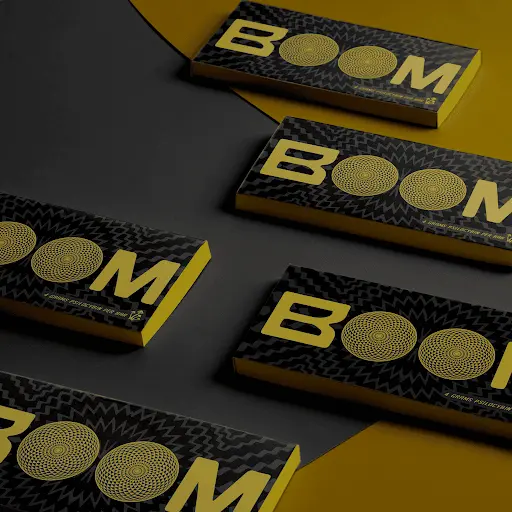
The term Boom bar can function as a brand or product reference, but a brand name does not necessarily describe the technical composition of an individual confection.
A particular product can have its own ingredient list and formulation even when it belongs to a recognizable product family.
When researching mushroom-based confectionery, brand information can provide general context, while product-specific labeling offers a more precise understanding of the actual ingredients.
Texture Can Reveal Formulation Differences
The mouthfeel of a confection often reflects its underlying structure.
Chocolate generally aims for a smooth texture and controlled melting behavior. Powdered ingredients can introduce additional particles and alter this experience.
Gummies depend on elasticity and chewiness, with texture controlled by gel-forming ingredients, moisture, sugar concentration, and processing.
Molded sweets can have firmer or softer structures depending on their formulation.
Consequently, the same mushroom-derived ingredient may create different sensory experiences when incorporated into different confectionery bases.
Storage and Stability Considerations
Confectionery products are affected by environmental conditions.
Chocolate can be sensitive to heat and humidity, which may affect its appearance, texture, and physical structure. Gummies can also respond to changes in moisture and temperature.
The addition of mushroom-derived ingredients can introduce further formulation considerations depending on their physical properties.
Packaging helps protect the product from environmental exposure, while storage instructions provide information specific to the finished formulation.
Quality Control in Mushroom Confectionery
Specialty confectionery requires consistency in both ingredients and manufacturing.
Raw materials may vary in moisture, particle size, composition, and quality. These factors can influence how the finished product performs.
Manufacturers can use quality-control procedures to assess raw materials and finished batches. Depending on the product, testing may involve microbial quality, allergens, contaminants, ingredient identity, or other characteristics.
Products containing specialized or regulated ingredients may have additional requirements depending on local law.
Why Clear Terminology Matters
The mushroom confectionery market contains several overlapping terms.
“Mushroom chocolate” is a broad description. “Functional mushroom” refers to a category commonly used in food and supplement discussions. “Powder” and “extract” describe different ingredient forms, while “blend” can indicate multiple mushroom ingredients.
Psychoactive mushroom terminology belongs to another category altogether.
Using these terms accurately helps prevent confusion and makes product descriptions easier to interpret.
The Direction of the Market
Mushroom-based confectionery is part of a wider movement toward experimental food formulations.
Future products may explore new mushroom species, plant-based chocolate, alternative sweeteners, fruit combinations, spices, coffee, nuts, and other specialty ingredients.
Processing improvements may also make it easier to incorporate mushroom-derived materials while maintaining consistent texture and flavor.
As the market develops, transparent labeling and precise terminology will become increasingly important.
Frequently Asked Questions
What are mushroom-infused confectionery products?
They are sweets containing mushroom-derived ingredients such as powders, extracts, or blends.
Can mushroom ingredients be added to chocolate?
Yes. Mushroom-derived materials can be incorporated into different chocolate formulations.
Are mushrooms used in gummies?
Yes. Mushroom ingredients can be incorporated into gummy formulations alongside conventional confectionery ingredients.
Which mushrooms are commonly associated with functional foods?
Lion’s mane, reishi, cordyceps, and turkey tail are frequently discussed in this category.
Does mushroom powder have the same characteristics as extract?
No. They are produced differently and can behave differently in food formulations.
Are mushroom confectionery products always psychoactive?
No. Many products contain non-psychoactive mushroom ingredients.
Why is the ingredient list important?
It identifies the actual components used in the formulation and can clarify the type of mushroom preparation present.
Can mushroom confectionery contain allergens?
Yes. Supporting ingredients may include milk, soy, peanuts, tree nuts, or other allergens.
Conclusion
Mushroom-infused chocolate and confectionery products combine established candy-making techniques with a diverse range of mushroom-derived ingredients. Their characteristics depend on far more than the presence of a mushroom.
The species, processing method, chocolate or candy base, flavor system, texture, supporting ingredients, and product format all influence the final formulation.
For newcomers, the most useful approach is to look beyond broad product terminology. Understanding the difference between functional and psychoactive mushroom categories, recognizing the distinction between powders and extracts, and reading ingredient labels carefully can provide a much clearer picture of the products within this evolving specialty-food market.
As manufacturers continue experimenting with mushroom ingredients, the category is likely to become even more varied, making accurate terminology and transparent product information increasingly important.